Thinkbox: an LLM Knowledge Base with a Public Surface
I think out loud. That’s not a personality trait — it’s a method. Writing a thought down forces you to finish it. Publishing it forces you to finish it honestly.
A few weeks ago I started doing this on Twitter with a constraint: one thought per tweet, 280 characters, no threads longer than necessary. I called the practice xettel — Zettelkasten, but with Twitter as the medium. Each tweet is a card. Replies grow a thread. Bridge tweets connect ideas across threads. The structure builds itself the way a good note system should — not by filing, but by linking.
The constraint matters. 280 characters means you can’t hide behind qualifications. Either the thought stands on its own or it doesn’t. Six months later, a stranger should understand it without context. That’s the test.
The missing half
Writing worked. Reading didn’t. I’d come across an article or a paper, find it interesting, and have no structured way to hold onto what I learned. Bookmarks rot. Highlights without context are useless a week later.
Then Karpathy described a pattern he called the “LLM wiki” — you feed sources into an LLM, it maintains a structured wiki, and you query it later. Ingest, query, lint. Markdown files in git. The LLM writes the wiki pages — one per concept, one per entity, one per source — cross-references them, and keeps them consistent. You curate what goes in and ask questions. The LLM does the bookkeeping.
I took the pattern and wired it into what I already had.
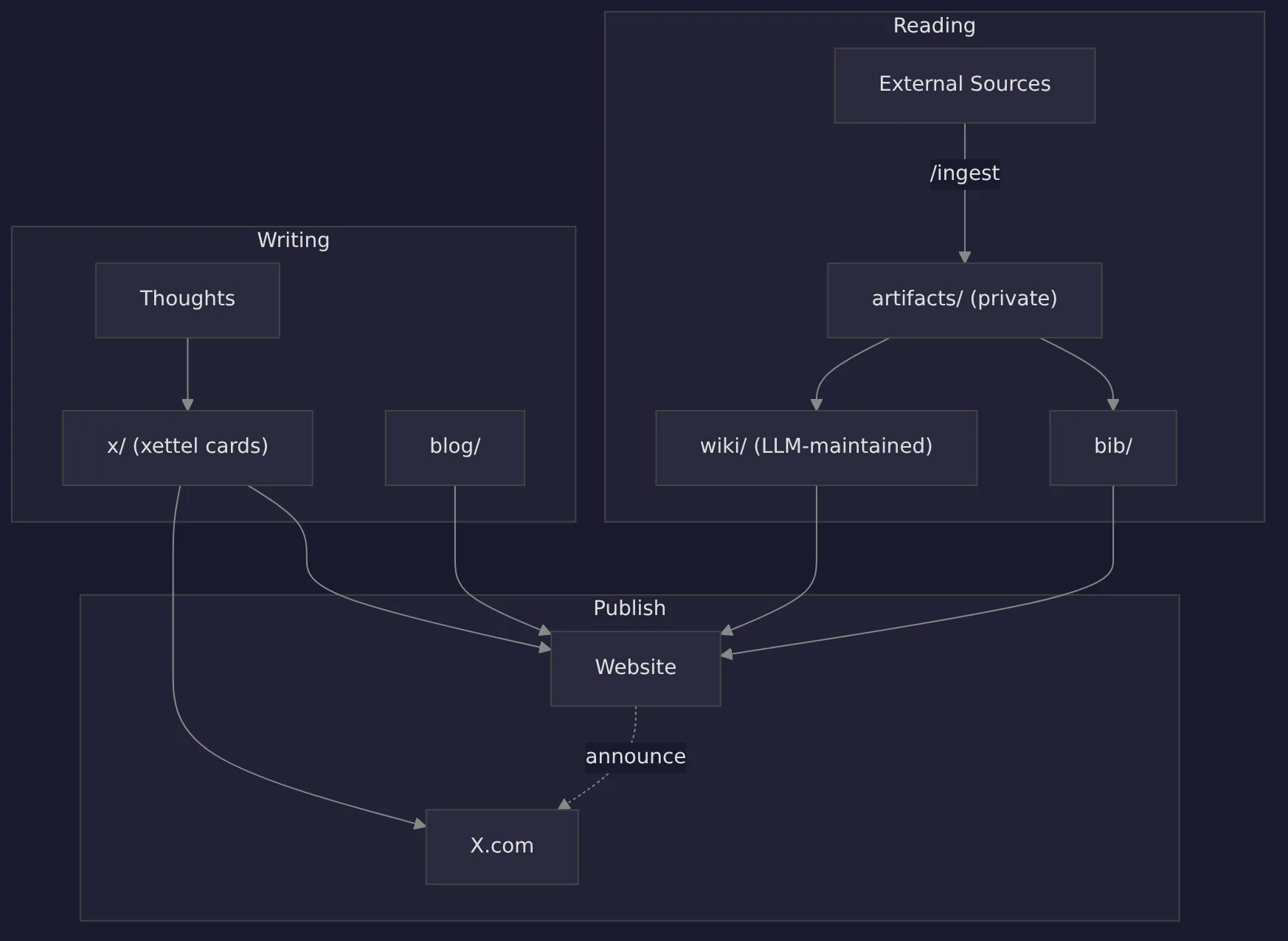
Now when I read something, I ingest it. The LLM reads the original — not a summary, the actual source — extracts the ideas, writes wiki pages, links them to what’s already there. A bibliography tracks provenance. Maps of Content organize everything by topic. If the new source contradicts something I’ve tweeted, the wiki notes the disagreement and links to both. I don’t have to remember where I read what. The system remembers.
Thinking in public
Here’s what makes this different from a private knowledge base: everything publishes to andysmith.ai. The wiki pages, the bibliography, the blog posts, the xettel cards — all publicly accessible. The knowledge base is a website.
This isn’t a feature. It’s the point.
When a thought lives at a URL, it enters a conversation. Someone quotes a tweet, challenges a position, points to a source I haven’t seen. I ingest their reference, and the wiki grows. A private wiki is a monologue. A public one is a conversation — and the quality of a knowledge base depends not just on what you put in, but on what others bring to it.
The practice is simple: think, write, publish, read, ingest, connect. The writing side is xettel. The reading side is the LLM wiki. The public surface ties them together.
Thinkbox
The system that holds all of this is called thinkbox. It’s open-sourced — the architecture, the skills, the conventions.
The content is personal. My wiki, my cards, my bibliography — those are mine. But the system is generic. Fork the repo, point it at your own content directory, and you have the same setup: an LLM that maintains your wiki, a site that publishes it, and Twitter as the layer where thinking happens in public.
This post is itself an example. It lives in the content repo, publishes to the site, and gets a tweet. The system is the message.