Thinking Through the Box
I have a box of thoughts. Hundreds of atomic ideas, each one a tweet, each one linked to others by replies and bridges. I call the practice xettel — Zettelkasten with Twitter as the medium.
The box works. I write a thought, it connects to previous thoughts, and over time a structure emerges. But for the first few weeks I noticed a problem: the box was filling up with aphorisms. Clean sentences, self-contained, individually true — but disconnected. A collection of aphorisms is not a thinking tool. For a box of thoughts to work, each thought needs its connections and counter-arguments alongside it.
The issue wasn’t the format. The issue was the process. I was writing thoughts as they came to me — polishing them, publishing them, moving on. What I wasn’t doing was thinking through them. Testing them. Arguing with them.
The missing step
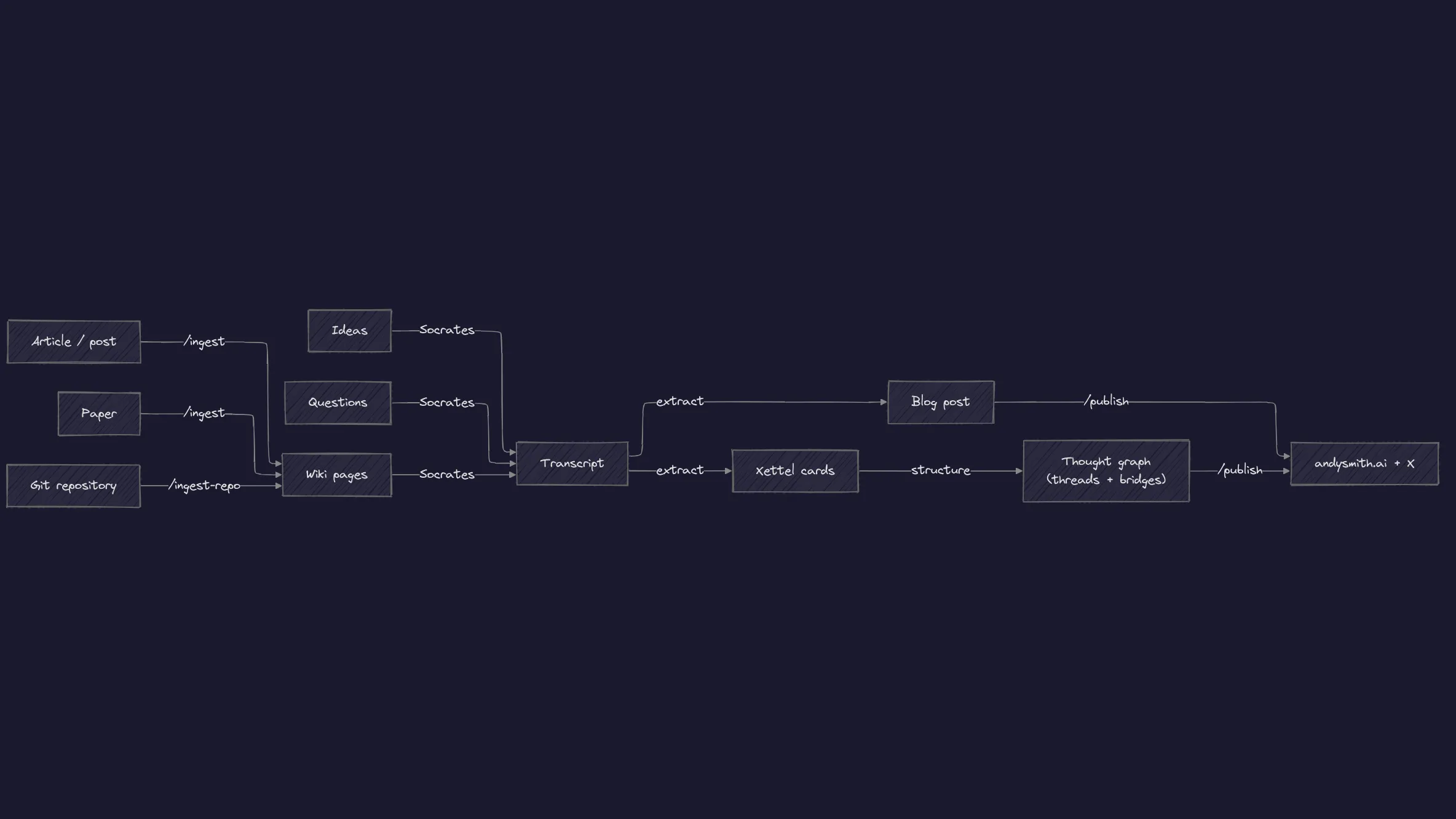
Thinkbox already had two skills for processing knowledge. Ingest extracts ideas from external sources — articles, papers, books. Xettel captures my own atomic thoughts. But there was a gap between the two: the moment where external knowledge becomes my understanding. Learning is not collecting information — it’s integrating it into your worldview. If your picture of the world didn’t change, you didn’t learn.
I needed a process that would force integration. Not just “I read this and it’s interesting” but “I read this, here’s what I think about it, here’s where I disagree, here’s what changes in my existing picture.”
The answer turned out to be old. Twenty-four centuries old.
Socrates as an LLM skill
The Socratic method, stripped to its core, is simple: someone asks you questions until you either articulate what you actually think or discover that you don’t know what you think. The key insight is that the questioner is not a mirror — they’re an opponent. Not hostile, but not agreeable either.
I built this as a skill in thinkbox. The agent asks questions. It challenges my claims. It presents counter-arguments — sometimes from my own knowledge base (my past self disagreeing with my present self), sometimes from established positions in the literature. When I disagree with a counter-argument, I have to say why. Disagreement is the most valuable thing in science — but only when argued.
This is science without bureaucracy. No committees, no peer review panels — just argumentation, evidence, and willingness to change your mind. Anyone can do science. You need a question, evidence, and willingness to be wrong.
How a session works
The method starts simple. A complex question paralyzes — a simple one creates an entry point and momentum. “What do you think about X?” where X is something specific, concrete. I answer in one sentence. That sentence becomes the thread to pull.
Then the questions escalate. Why do you think that? What are you assuming? What would someone who disagrees say? Where does this stop being true? Each question forces me to go one level deeper. Once momentum is there, depth follows naturally.
Everything is recorded. The agent keeps a transcript — my words close to verbatim, the agent’s contributions compressed to a few words. The transcript belongs to me. It’s a raw record, and a raw record is worth more than a polished post — from the raw version you can cut many outputs, from a polished one you can’t go back.
Two tasks, one process
Every session does two things simultaneously. First, it extracts — pulls out what I already know but haven’t articulated. Responding before formulating teaches you what you actually believe. The questions act as probes, and the answers surprise me as much as anyone.
Second, it integrates — changes my understanding by incorporating whatever triggered the session. An article, a post, a half-formed idea. Learning is two simultaneous acts: extracting what you already know but haven’t articulated, and integrating new knowledge into your existing picture of the world.
The two tasks feed each other. You can’t integrate new knowledge without first surfacing the old. And surfacing the old often reveals gaps that new knowledge fills.
Verification
A fair objection: if the agent asks the questions and records the answers, where’s the external check? Three places.
First, during the dialogue itself — self-verification. Explaining your position to an opponent clarifies it faster than explaining it to yourself. The agent is not a rubber duck. It has positions — drawn from my knowledge base and from general knowledge — and it pushes back.
Second, through literature. Thinkbox has an ingest skill that cross-references my thoughts against published sources. If my card contradicts a well-established position, I’ll see it when the source is added.
Third, through readers. Everything publishes. Learning in public is not sharing results — it’s exposing your reasoning to challenge. Right now the audience is small. Over time, the people who find this interesting will become external verifiers.
Becoming smarter in private is safe but unchecked. Becoming smarter in public invites challenge — and challenge is the cheapest verification there is.
What I learned by dogfooding
I designed this skill by using it. The first session was about the skill itself — a Socratic dialogue about how Socratic dialogues should work. This is what came out.
The agent’s first instinct was to propose three clean, self-contained cards and call it done. But the thoughts in the box are atomic, yet connections give them a world. Three isolated aphorisms don’t capture a reasoning chain. They can’t be walked — a walk through connected cards produces a new view of the world, not new thoughts, because the thoughts are already there, but the path between them is new.
So I pushed for more. Not three cards — twenty-two. Threads, not isolated roots. Every transferable thought from the session, with reply chains that reconstruct the argument. The fear isn’t publishing too many thoughts. The fear is losing one important one. Better to save too many thoughts than to lose one. You can always delete — you can never recover what you didn’t record.
I also learned that the agent needs a checklist. Not because it can’t think without one — but because a checklist guarantees that specific concerns are addressed. Is this the user’s thought or the agent’s interpretation? Is the card self-contained? Is it written in scientific style? Are there neighboring cards to connect to? Without the checklist, the agent forgot the scientific style. With the checklist, it can’t.
The comfort problem
There’s a reason this works and simple note-taking doesn’t. Note-taking is comfortable. No one disagrees with your notes. Comfort of being unchallenged is not safety — it’s a widening gap between your self-model and reality.
The Socratic agent is uncomfortable by design. It asks questions I don’t have answers to. It points out contradictions I’d rather not see. It reminds me of things I wrote six months ago that disagree with what I’m saying now. The earlier you learn you’re wrong, the less it costs.
What matters is becoming a little smarter, a little closer to truth, a little more experienced. The method is secondary. But the method has to include discomfort, or it’s not working.
The box thinks with you
A Zettelkasten, properly used, is not a filing cabinet. It’s a conversation partner. You put thoughts in, you walk through them, and new thoughts emerge from the paths between existing ones. Luhmann said his slip-box was a communication partner. I believe him now.
The Socratic skill makes this explicit. The box doesn’t just store — it talks back. Through the agent, it surfaces contradictions, draws connections, asks questions. You can read a text or read yourself reading it — the second produces self-knowledge.
This is what thinking through the box means. Not thinking about the box, not thinking into the box — thinking through it. The box is the medium. The thoughts pass through it and come out different.
The Socratic skill is part of thinkbox. The first session’s twenty-two cards are public on andysmith.ai.